Cap de Formentor
Back to all places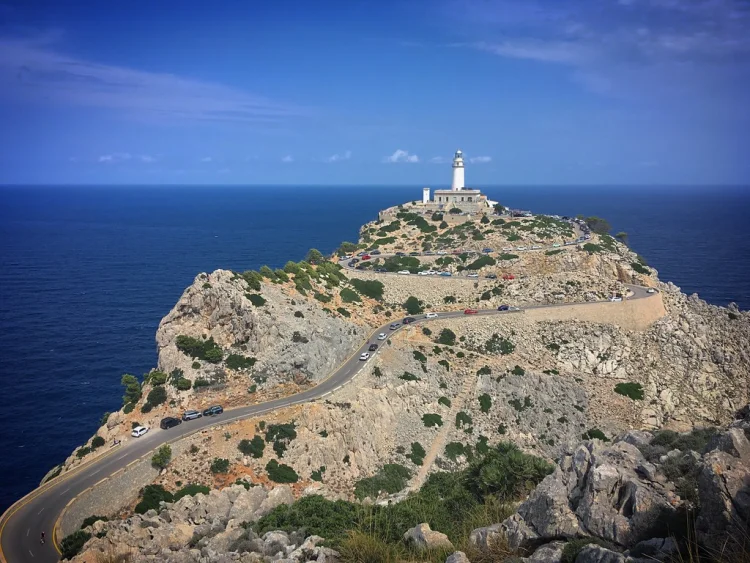
Cap de Formentor stands as a breathtaking natural landmark located on the northernmost point of the Balearic Island of Mallorca, Spain. Rising majestically with its highest peak, Fumat, at 384 meters above sea level, the cape is affectionately known by the Mallorcans as the "Meeting point of the winds."
This windswept peninsula not only captivates with its rugged beauty but also offers a fascinating tapestry of history and culture. Among its bays are the picturesque Cala Figuera, Cala Murta, and Cala Pi de la Posada, which add to the charm of the area.
A significant historical landmark is the Formentor Lighthouse, inaugurated in 1863 after an arduous construction process made challenging by the remote location accessible only by sea or a lengthy mule track. This iconic lighthouse, beaming from the cape’s extremity, marks a vital navigational point for sailors.
The region’s literary heritage was enriched by Miquel Costa i Llobera, a celebrated Mallorcan poet who penned the renowned poem, The Pine of Formentor, and once owned the cape lands. Following his death, the land was parcelled and sold, leading to the establishment of the luxurious Hotel Formentor in 1928 by Argentinean art enthusiast Adan Diehl.
Connecting the cape to the mainland is a 13.5 km road designed by Mallorcan engineer Antonio Parietti in 1925, renowned for its serpentine style that adapts to the challenging topography. Parietti, already famous for constructing the winding road to Sa Calobra, once again showcased his engineering prowess with this coastal route, which remains a marvel to this day.
The cape is adorned with various viewing points, such as the Mirador del Mal Pas, also known as Mirador d’es Colomer, from where visitors can enjoy spectacular vistas that stretch to Menorca in the east, Cala Figuera in the west, and Alcudia’s sandy beaches to the south. However, the steep cliffs below provide a dramatic setting not recommended for those with vertigo.
In the southeastern part of the cape, near Racó de Xot, a cave with a striking opening into the sea serves as an essential archaeological site. Its two entrances, about eight meters above the waterline, lead into a 90-meter-long cave with an eight-meter ceiling, rich in artifacts from the prehistoric talaiot culture.
Beyond its geographical and historical allure, Cap de Formentor is steeped in legends, such as tales of ghost ships that allegedly roamed its waters and stories of winds so fierce they were believed to carry messages from the gods.
Photo: Sergei Gussev
39.95017, 3.19554